How the knitting chart maker works
- Add a picture. Drop, choose or paste any JPG, PNG or WebP. You can also type a name or a short word, start from a blank grid, or load one of the built-in samples.
- Enter your gauge and width. Type the stitches and rows you get over 4 inches (10 cm) on your swatch, then pick how many stitches wide the motif should be. The page tells you the finished size in inches and centimeters.
- Choose your colors and technique. Pick from 2 to 12 colors and say whether you are knitting stranded, intarsia, duplicate stitch or double knitting, flat or in the round.
- Check, edit and take it with you. Look at the knitted preview, fix single stitches by hand, then download the chart, print it, or follow it row by row on screen.
You may know this kind of tool as a knitting pattern maker or a knitting graph generator. It is the same job: a grid where every cell is one stitch. Nothing is sent to a server. The picture is read, resized and charted inside your browser.
Why a knitting chart needs cells shaped like your stitches
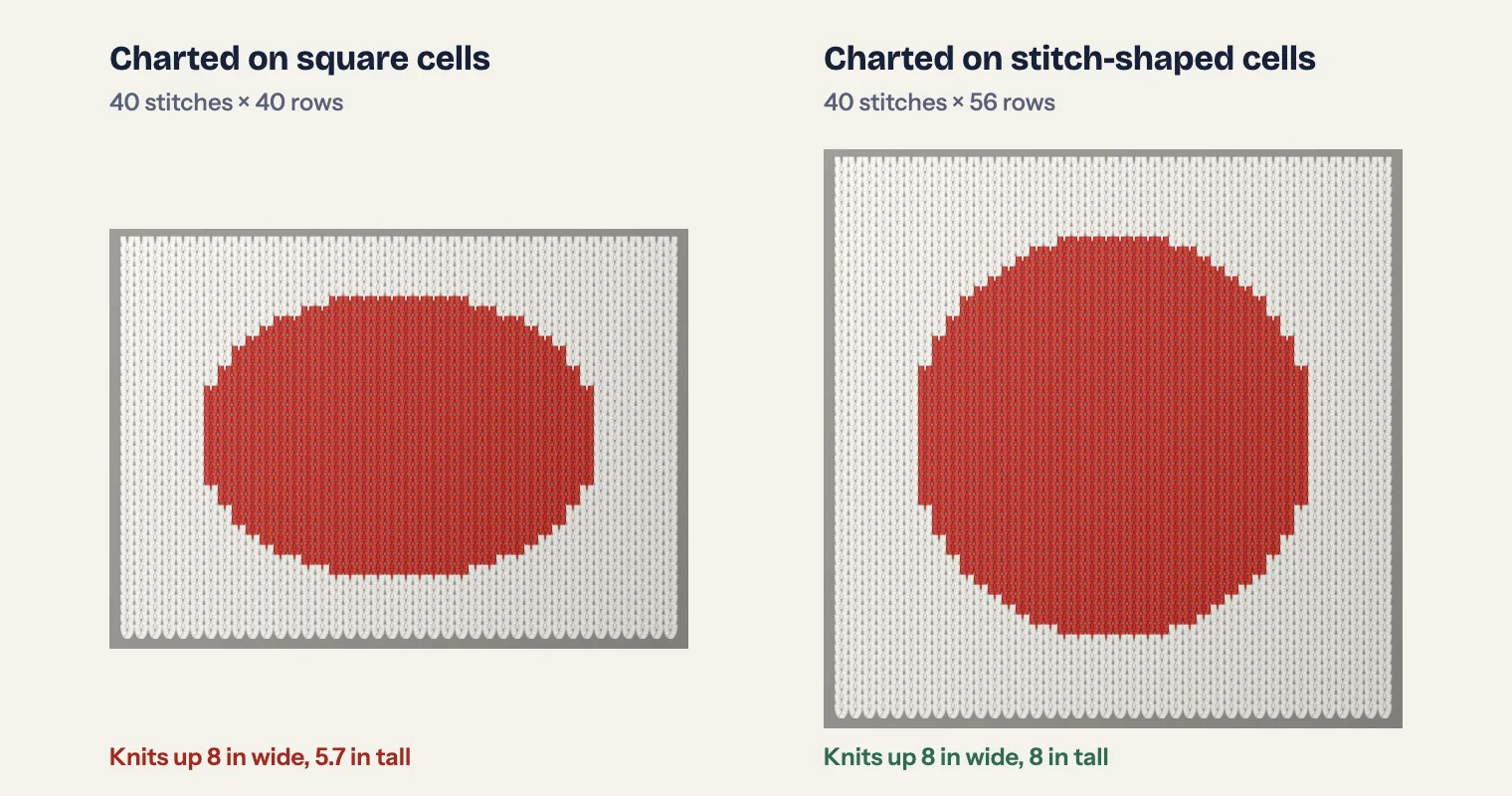
A stockinette stitch is not square. It is wider than it is tall, and how much wider depends on your yarn, your needles and your hands. That is what gauge measures. At a gauge of 20 stitches and 28 rows over 4 inches, one stitch is 4 ÷ 20 = 0.20 inches wide and 4 ÷ 28 = 0.14 inches tall. The ratio is 1.4 to 1.
Now take a square picture and chart it 60 stitches wide on ordinary square graph paper. You get 60 rows. Knit those 60 rows and the piece is 12 inches wide but only 60 × 0.14 = 8.6 inches tall. The picture has lost 29% of its height. Circles turn into ovals and faces look pressed flat.
If you would rather draw by hand, the knitting graph paper generator prints paper with the same proportions, and the gauge calculator turns a swatch measurement into the two numbers this page asks for.
Picture to knitting chart: how to get a clean result
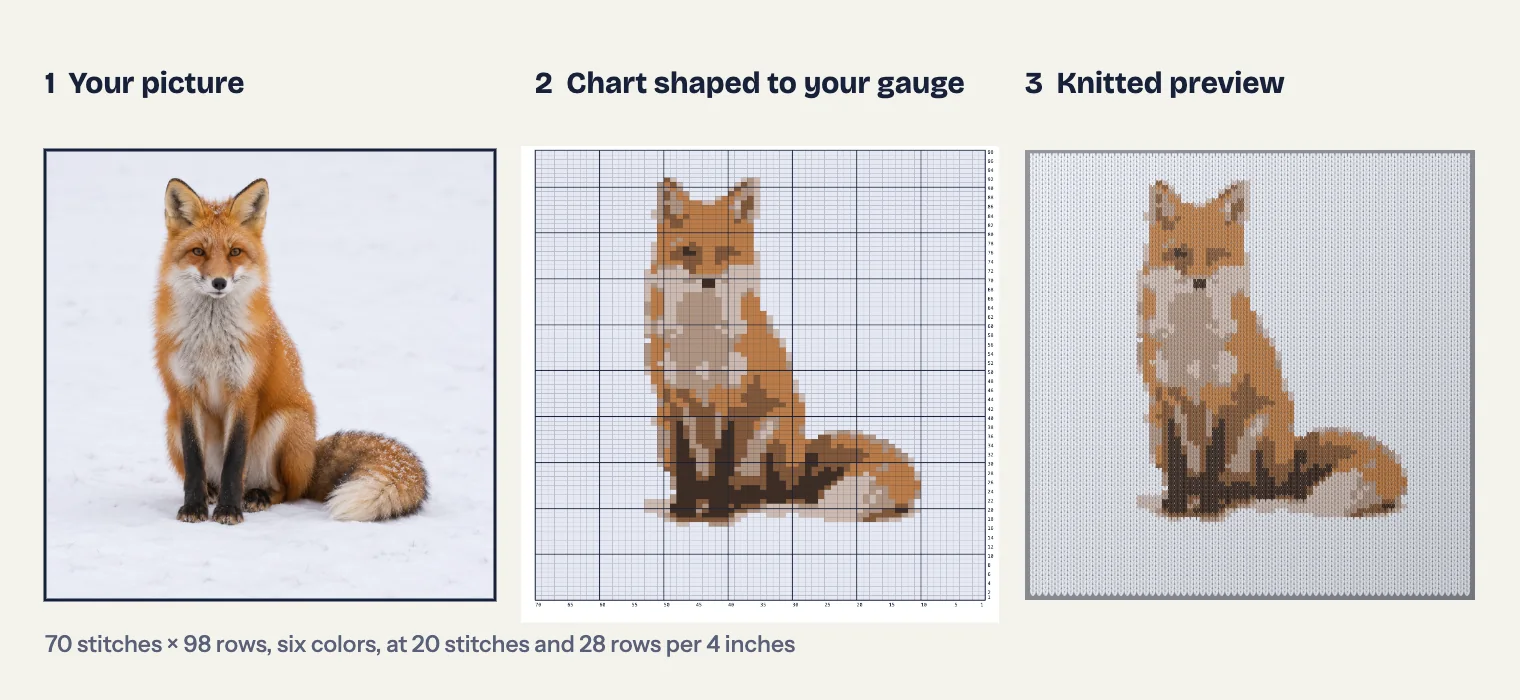
A photo holds millions of colors and a chart holds a handful, so the conversion is a simplification. A few choices make the difference between a chart you can knit and one that looks like static.
- Start with a clear subject. One animal, one flower, one face against a plain background charts far better than a busy scene. Crop tightly before you upload.
- Give detail enough stitches. Every stitch is one dot. Bold shapes work at 30 to 40 stitches wide. Lettering needs about 7 stitches of height. A recognizable face usually needs 80 or more.
- Use fewer colors than you think. Each extra color is another ball of yarn to manage. Try 3 or 4 first and add one only when something important disappears.
- Keep the tidy setting on. It merges lone stitches into the color around them. Single stitches of a color are slow to knit and rarely show up in the finished fabric anyway.
- Finish by hand. Use Draw, Fill and Pick to sharpen an eye or straighten an edge.
Stranded, Fair Isle, intarsia or duplicate stitch
The same chart can be knitted in different ways, and the right one depends on how the colors are spread. Tell the chart maker which technique you plan to use and it adjusts its checks and its yarn estimate.
| Technique | Colors in one row | What happens on the back | Suits | What the tool does |
|---|---|---|---|---|
| Stranded, including Fair Isle | Two | The unused color is carried across as a float | Small repeating motifs, yokes, hats and mittens, usually in the round | Keeps rows to two colors if you ask, flags long floats, adds float yarn to the estimate |
| Intarsia | Any number | Each area has its own length of yarn, twisted at the joins | Large blocks of color and pictures, worked flat | No row limit, no float check |
| Duplicate stitch | Any number | Nothing: the color is embroidered over finished stockinette | Small details, initials, a few stitches of a third color | Same chart, read stitch by stitch |
| Double knitting | Two | A second layer with the colors swapped | Reversible scarves and blankets | Two-color chart, no float check |
Check your floats before you cast on
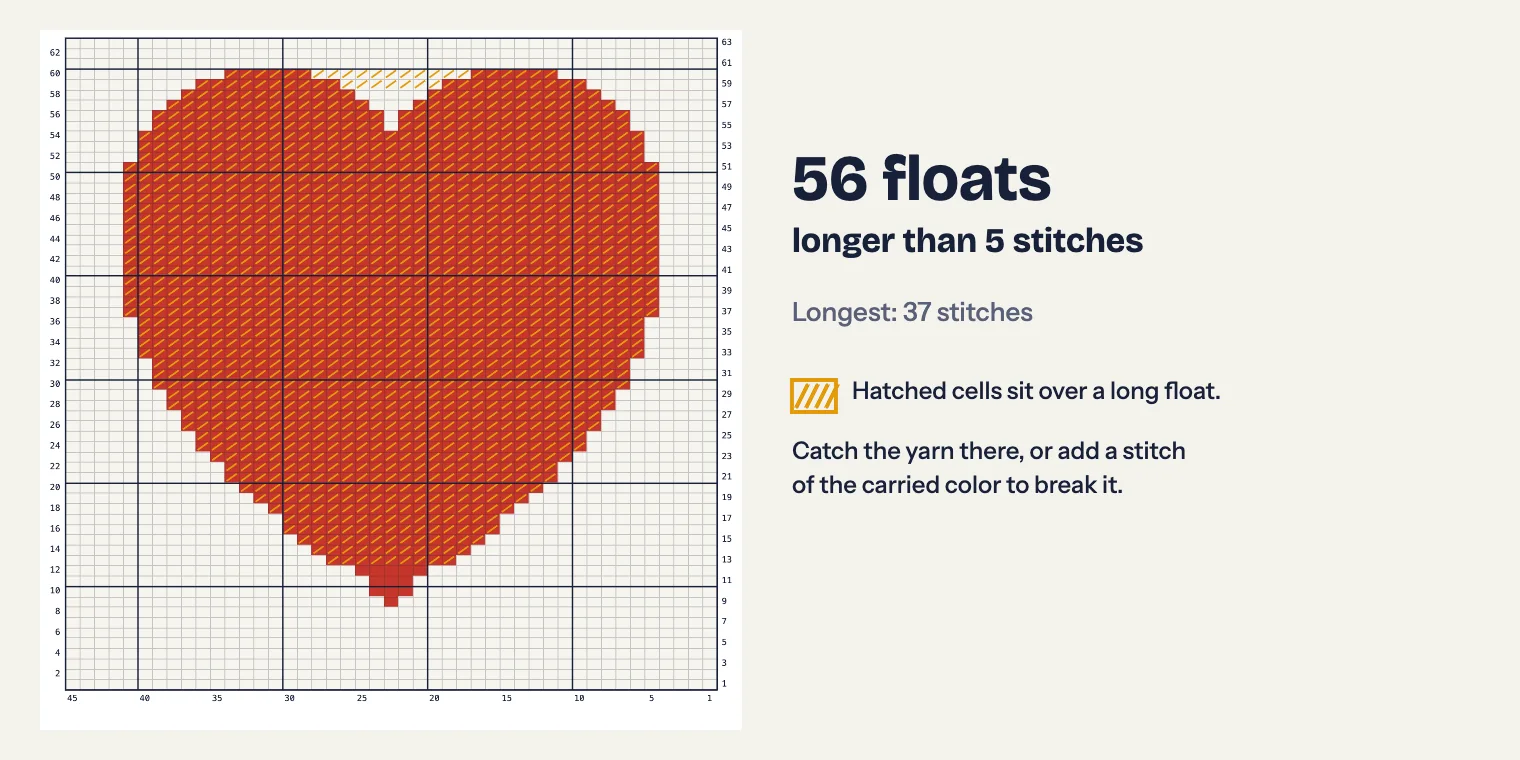
In stranded knitting the color you are not using travels across the back of the work until it is needed again. That strand is a float. Short floats make a warm, stable fabric. Long ones catch on fingers and buttons and pull the fabric in. Common advice is to catch any float longer than about 5 stitches, or about an inch, by trapping it with the working yarn.
With the technique set to stranded, the chart maker measures every float in every row. Cells that sit over a float longer than your limit are hatched in amber, and the line under the chart tells you how many there are and how long the longest one is. You then have three choices: add a stitch of the carried color to break the float, plan to catch it there, or switch that part of the design to intarsia. When you knit in the round, the float that wraps from the end of one round to the start of the next is counted too.
Reading the chart and the written rows
Charts on this page follow the usual conventions, so they read like the ones in printed patterns.
- Row 1 is the bottom row. You knit upward.
- Worked flat, right-side rows are read right to left and are knitted. Wrong-side rows are read left to right and are purled. Odd row numbers sit on the right edge and even ones on the left, where each row begins.
- Worked in the round, every round is read right to left.
- Heavier lines mark every 10 stitches and every 10 rows, counted from the bottom right corner.
- Each color has a letter. Turn on Symbols if you are printing in black and white.
The Written rows tab says the same thing in words, for example Row 7 (RS): k5 A, k3 B, k9 A. Knit mode highlights one row at a time on the chart and shows its wording above it. Tap Next row when you finish a row. Your place is saved on the device.
How much yarn each color needs
Next to each color you will see a stitch count and a rough yardage. The estimate allows about 4.5 times the width of a stitch for every knitted stitch, and in stranded work another 1.1 times the stitch width for every stitch a color is carried behind. At 20 stitches per 4 inches a stitch is 0.2 inches wide, so each one uses about 0.9 inches of yarn. The 45 by 63 sample chart has 2,835 stitches, which comes to roughly 71 yards before floats.
Treat these numbers as a guide for choosing between one ball and two, and buy a little extra.
A free knitting pattern maker you can take anywhere
Once the chart looks right, you have five ways to use it:
- Download chart (PNG) gives one image with the color key, the size and your gauge.
- Print or save as PDF splits a large chart across pages, numbers the rows and stitches on each page, and adds the written rows at the end.
- Copy written rows puts the row-by-row text on your clipboard, ready for a pattern draft.
- Copy share link makes a link that reopens this exact chart for a test knitter or a friend. The chart travels inside the link itself.
- Knit mode turns the page into a row counter for this chart.
The charts are yours. Use them for gifts, for patterns you sell, or for finished pieces you sell.
Knitting chart maker questions
Is this knitting chart maker free?
Yes. Every feature on this page is free and there is no account. You can download the chart as a PNG, print it or save it as a PDF, copy the written rows and share a link. Your picture is processed in your browser and is never uploaded.
How do I convert a picture to a knitting chart?
Drop the picture into the box at the top of the page. Set the width in stitches, enter your gauge from a swatch, and choose how many colors you want to knit with. The chart, the knitted preview and the written rows update straight away. Fix any stitch by hand with the Draw tool, then download or print.
Why does my knitted picture look squashed?
Because a knit stitch is wider than it is tall. At 20 stitches and 28 rows over 4 inches, each stitch is 0.20 in wide and 0.14 in tall. A design drawn on square graph paper comes out at about 71% of its drawn height. This chart maker adds the extra rows for you, so the knitted piece matches the picture.
How many stitches wide should my chart be?
Multiply the finished width you want in inches by your stitches per inch. A 9 inch motif at 5 stitches per inch is 45 stitches. For detail, think in stitches rather than inches: a bold shape reads well at 30 to 40 stitches, lettering needs about 7 stitches of height per line, and a recognizable face usually needs 80 stitches or more.
How long can a float be in Fair Isle knitting?
Common advice is to catch any float longer than about 5 stitches, or about 1 inch, so fingers and buttons do not snag on it and the fabric does not pucker. The chart maker flags floats longer than 5 stitches by default, and you can set the limit anywhere from 3 to 9.
Can I sell patterns or finished items made from these charts?
Yes. Charts you make here are yours, for personal or commercial use. Only use pictures you have the right to use. Logos, characters and artwork that belong to someone else stay theirs.
Does it work on a phone or tablet?
Yes. It runs in any modern browser with nothing to install. Your chart is saved on the device, and Knit mode lets you tap through one row at a time while you work.
Can I use it for crochet or cross stitch?
For cross stitch, choose the Square grid gauge so the cells are 1 to 1. For crochet there are two dedicated tools: the C2C crochet pattern generator writes diagonal rows, and the tapestry crochet pattern maker writes single crochet rows.